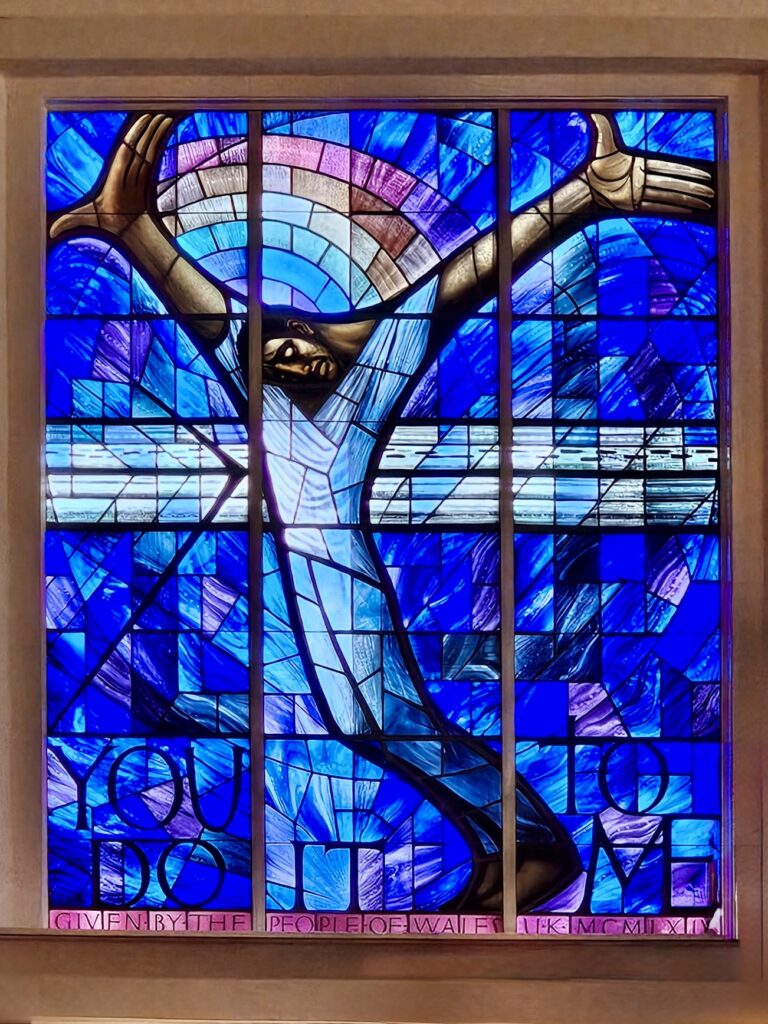
Our recent photo of “The Freedom Window for Alabama” (1964) in the 16th St. Baptist Church in Birmingham, AL by John Betts (1914-1991).
It’s all so countercultural: Once again I’ve experienced how sharing pain and empathy for unjust suffering is a blessing. Enduring painful truths together fosters and strengthens hope. Mutually experiencing sadness, frustrations, and anger associated with injustice strengthens our bonds of shared humanity and motivates us to work together toward justice and love.
It’s been just over a week since we returned from a 13-day self-directed pilgrimage through four states, TN, MS, AL, and GA. We immersed ourselves in the history of the Civil Rights Movement in the U.S. while also honoring a few of our southern ancestors. We knew we would be moved to tears many times during the course of our journey. There is no way around it: the suffering of, and injustice toward, African Americans in our country’s history are overwhelming.
All of this is illustrated in the story of “The Freedom Window of Alabama,” (1964). Welsh artist, John Betts heard about the white supremacist bombing that killed four young girls at the 16th St, Baptist Church in Birmingham, AL. His empathy led him to propose and design a window for the church to replace one of those shattered. He collected funds for the project from small donations from the people of Wales who also were moved by the horror of the bombing and other violent events making international news from our segregated south. The people of the church welcomed his care and collaborated in the design. An inscription in the window acknowledges the empathic gift from the people of Wales. Also, boldly integrated into the window is the caption, “You do it to me,” a statement not only about the past event, but about how we live in the present, with ongoing empathy.
Beginning a few days before the start of our journey and continuing through to the end, most days we said aloud a prayer I had written thanking Love for being able to make this pilgrimage. It expressed our experience that empathy and love work toward justice and against injustice. In one way or another, all along our route, we were asked, “Why? Why are you making this trip?” Bottom line, the reason was the experience expressed in our prayer, empathy actively works against injustice. It motivated our journey, strengthened our desire to meet people along the way, and throughout was strongly reinforced in numerous ways.
While we knew we would shed numerous tears, we didn’t know we would meet numerous people along our way who would be welcoming and generous with their perspectives. They shared their perspectives on our shared painful history and our government’s current efforts to repeat history in frightening and hurtful ways. We didn’t know that every one of the people we talked with would appreciate our trying to empathically acknowledge those who suffered and suffer unjustly, and those who courageously persevered trying to bend “the arc of the moral universe” toward justice. We hoped, but didn’t know for sure, that sharing our mutual empathy with each other would strengthen the desire and hope within all of us that our unjust history wouldn’t repeat itself more than it already is.
That shared empathy began with simple friendly greetings often in the midst of painful historic surroundings. Relatively quickly, personal connecting led to acknowledging shared values. Sharing strengthened the hope we all try to muster each day.
Viewing so many exhibits from our country’s history of racial injustice could not help but provoke visions of how, in many ways, our present is regressing to our past. The federal government, its many elected supporters, and the Supreme Court, once again are working to limit voting rights. Once again, whole groups of people are painfully scapegoated, even killed, in addition to African Americans, immigrant families are aggressively fractured and members deported. Freedom and equality under the law are again being devalued as we move away from the values of diversity, equity, and inclusion. Once again, truth and education are being distorted as our history is being rewritten, whitewashed, to reflect an abusive, white, male, Christian nationalism and justify the grotesquely unequal distribution of wealth and power.
Stained glass windows are difficult to perceive in darkness, but even in the dark, it is our shared empathy that blesses us with hope and the motivation to continue acting, persevering to make a positive difference in our country and world.
Share your thoughts